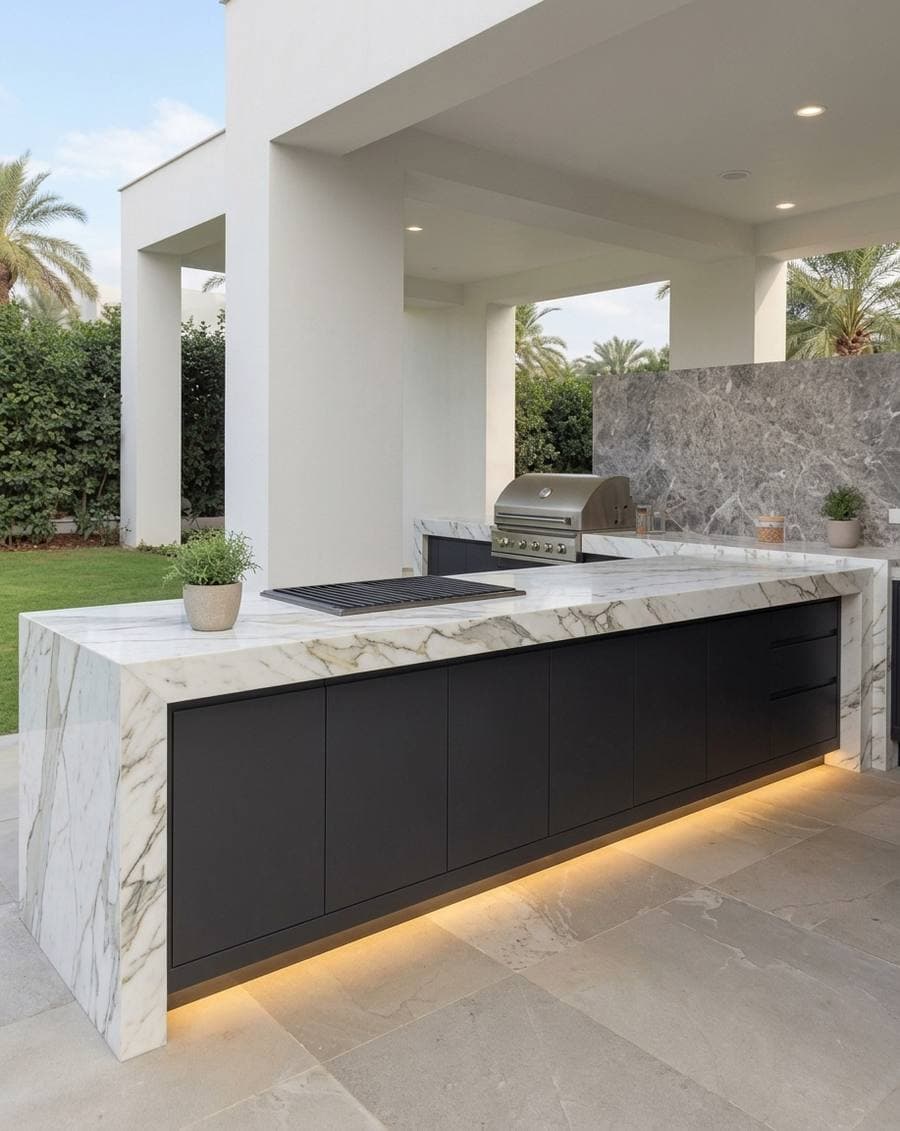
The failure you can set your watch by
A resin-based quartz worktop beside a BBQ island lives a hard life: midday UV, evening cooldown, radiant heat from the grill, and a splash of olive oil for good measure. Within two to three seasons, the pattern is familiar, yellowing around heat zones, micro-crazing along cutouts, and stains that no longer lift.
The chemistry is straightforward. Polyester and acrylic resins degrade under ultraviolet light and lose stiffness as temperatures climb. The stone particles are innocent; the binder is the weak link.
Why inorganic bodies survive
Inorganic quartz replaces resin with a silicate or cementitious binder that simply does not yellow, and crystallized glass goes further still: a zero-porosity, high-temperature body with Mohs hardness above 6 and water absorption of effectively zero.
Thermal cycling that crazes a resin board, winter freeze to grill-side heat, passes through these bodies without dimensional drama. Stain agents sit on the surface instead of wicking in, so maintenance is a wipe rather than a reseal.
What to write in the spec
Require UV exposure test data with a declared Delta E limit, a zero-resin or silica-free declaration as appropriate, and stain resistance evidence against oil and wine. Then verify the fabrication: heat-zone cutouts need radiused corners and adequate clearance from open flame, whatever the material.
The stone particles are innocent; the binder is the weak link.